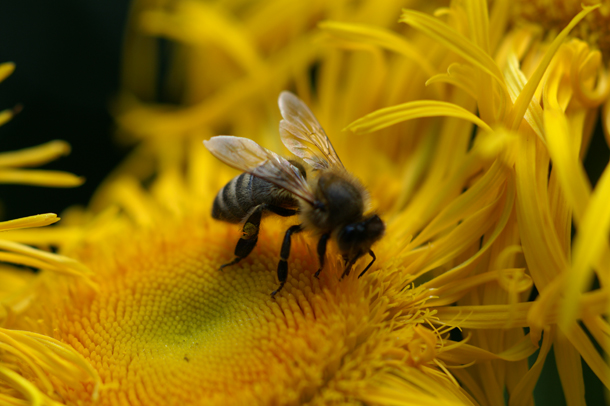
Why We Need Bees:
Why We Need Bees:
Why saving the bees is so important for our world.
Why Bees?
Bees
- Gardening For The Bees
The gardener does not work alone; to be successful and produce beautiful flowers and healthy vegetables the gardener has many assistants lending a hand. The honey bee is one that pulls more than its…
–
- Bringing Back the Bees
Pollination is best described as the transfer of pollen from the anthers of a flower to the stigma of the same flower or of another flower. Pollination is an essential process if the flower is to be…
Bees
|
|
|
|
||
Amazzzzing Bee Facts
Bumble Bees
|
|||
| Size: 1″Shape: Oval, bee shapedColor: Black with yellow stripes | Legs: 6Wings: YesAntenna: Yes | ||
| Common Name: Bumble BeeKingdom: AnimaliaPhylum: Arthropoda | Class: InsectaOrder: HymenopteraFamily: ApidaeSpecies: Bombus | ||
DIETWorker bees gather both pollen and nectar from flowers to feed to the larvae and other members of the colony.
HABITATBumblebees often nest in the ground, but can be found above ground around patio areas or decks. They will sometimes build their nests in attics or under roof beams. If disturbed, bumblebees will buzz in a loud volume, and they will aggressively defend their nests.
IMPACTAs part of the aggressive defense of their nests, bumblebees will chase nest invaders for long distances. The bumblebee sting is one of the most painful stings. Swelling and irritation can last for days after you are actually stung.PREVENTION
- Bumblebees can be prevented through inspection of potential nesting areas and removal of potential nesting materials.
- Because bumblebees will sting when threatened, homeowners are advised not to address the infestation themselves. A pest management professional or beekeeper should be called in to help.
Carpenter Bees
|
|||
| Size: 1″Shape: Oval, bee shapedColor: Blue-black | Legs: 6Wings: YesAntenna: Yes | ||
| Common Name: Carpenter BeeKingdom: AnimaliaPhylum: Arthropoda | Class: InsectaOrder: HymenopteraFamily: ApidaeSpecies: Xylocopa | ||
DIET
Worker bees gather both pollen and nectar from flowers to feed to the larvae and other members of the colony.
HABITAT
Carpenter bees bore through soft woods to lay eggs and protect their larvae as they develop. Female carpenter bees will chew a tunnel into a piece of wood to build a nest gallery. The bits of wood she chews and deposits outside the nest are called “frass”. The tunnel openings usually look about one or two inches deep, but they can be up to 10 feet long! These tunnels usually have several rooms where the bees hold their eggs and food.
IMPACT
Carpenter bees do not pose a public health threat, but they can do cosmetic damage to the wood where they build their nests. Carpenter bees are beneficial because they pollinate plants that are ignored by Honeybees.
PREVENTION
- Carpenter bees can drill into almost any wood, but prefer bare wood, so painting and staining wood can sometimes deter them.
- However, they will sometimes attack stained or painted wood, and their nests can be hard to reach, so a pest management professional or beekeeper should be called in to help.
Honeybee
|
|||
| Size: 1/2″Shape: Oval, bee shapedColor: Golden yellow with brown bands | Legs: 6Wings: YesAntenna: Yes | ||
| Common Name: HoneybeeKingdom: AnimaliaPhylum: Arthropoda | Class: InsectaOrder: HymenopteraFamily: ApidaeSpecies: Apis | ||
DIETHoneybees produce honey from pollen and nectar of the plants they pollinate. They store the honey in honeycombs in their nests, which they use to feed their young in colder months.
HABITATHoneybee nests vary in size. They typically build their nests in tree crevices, but will occasionally build nests in attics or chimneys.
IMPACTHoneybees do sting, but they only sting once. The sting can be extremely painful if the stinger is not immediately removed from the skin. Persons allergic to insect stings will have a more severe reaction.
PREVENTION
- Because honeybee colonies can be extremely large and removal can be very messy, only a pest management professional or experienced beekeeper can safely remove a honeybee nest.
Killer Bee
|
|||
| Size: 1/2″Shape: Oval, bee shapeColor: Golden yellow with darker bands of brown. | Legs: 6Wings: YesAntenna: Yes | ||
| Common Name: Africanized Honey BeesKingdom: AnimaliaPhylum: Arthropoda | Class: InsectaOrder: HymenopteraFamily: ApidaeSpecies: Apis | ||
DIET
Worker bees gather both pollen and nectar from flowers to feed to the larvae and other members of the colony.
HABITAT
Africanized bees have small colonies, so they can build nests in unique places. They have been known to live in tires, crates, boxes, and empty cars.
IMPACT
Their venom is no more dangerous than regular honeybees-they just tend to attack in greater numbers, dramatically increasing the odds of having an allergic reaction to the venom. If you are chased by Africanized honeybees run in a zigzag pattern and seek shelter in a house or car. Do not jump in the water! They will just wait around until you come up for air.
PREVENTION
- Because of the aggressive nature of these pests, a pest management professional or beekeeper should be called in to help.
———-
Neat Facts About Bees
- There are three kinds of bees in a hive: Queen, Worker and Drone.
- Only the Queen in the hive lays eggs. She communicates with her hive with her own special scent called pheromones. The queen will lay around 1,500 eggs per day.
- The worker bees are all female and they do all the work for the hive. Workers perform the following tasks inside the hive as a House Bee: Cleaning, feeding the baby bees, feeding and taking care of the queen, packing pollen and nectar into cells, capping cells, building and repairing honeycombs, fanning to cool the hive and guarding the hive.
- Workers perform the following tasks outside the hive as Field Bees: Gathering nectar and pollen from flowers, collecting water and a collecting a sticky substance called propolis.
- Bees have two stomachs – one stomach for eating and the other special stomach is for storing nectar collected from flowers or water so that they can carry it back to their hive.
- The male bees in the hive are called drones. Their job in the hive is to find a queen to mate with. Male bees fly out and meet in special drone congregation areas where they hope to meet a queen. Male drone bees don’t have a stinger.
- If a worker bee uses her stinger, she will die.
- Bees are classified as insects and they have six legs.
- Bees have five eyes – two compound eyes and three tiny ocelli eyes.
- Bees go through four stages of development: Egg, Larvae, Pupae and Adult Bee.
- The bees use their honeycomb cells to raise their babies in, and to store nectar, honey, pollen and water.
- Nectar is a sweet watery substance that the bees gather. After they process the nectar in their stomach they regurgitate it into the honeycomb cells. Then they fan with their wings to remove excess moisture. The final result is honey.
- Bees are the only insect in the world that make food for humans.
- Honey has natural preservatives and bacteria can’t grow in it.
- Honey was found in the tombs in Egypt and it was still edible! Bees have been here around 30 million years.
- A honeybee can fly 24 km in an hour at a speed of 15 mph. Its wings beat 200 times per second or 12,000 beats per minute.
- Bees have straw-like tongues called a proboscis so they can suck up liquids and also mandibles so they can chew.
- Bees carry pollen on their hind legs called a pollen basket. Pollen is a source of protein for the hive and is needed to feed to the baby bees to help them grow.
- A beehive in summer can have as many as 50,000 to 80,000 bees. A bee must collect nectar from about 2 million flowers to make 1 pound of honey. It requires 556 worker bees to gather a pound of honey. Bees fly more than once around the world to gather a pound of honey.
- The average worker bee makes about 1/12 th of a teaspoon of honey in her lifetime.
- Bees have 2 pairs of wings. The wings have tiny teeth so they can lock together when the bee is flying. Bees communicate through chemical scents called pheromones and through special bee dances.
- Every 3rd mouthful of food is produced by bees pollinating crops. Flowering plants rely on bees for pollination so that they can produce fruit and seeds. Without bees pollinating these plants, there would not be very many fruits or vegetables to eat.
- A single beehive can make more than 100 pounds (45 kg) of extra honey. The beekeeper only harvests the extra honey made by the bees.
- The average life of a honey bee during the working season is about three to six weeks. There are five products that come from the hive: Honey, beeswax, pollen, propolis, and royal jelly.
- Beeswax is produced by the bees. Bees have special glands on their stomach that secrete the wax into little wax pockets on their stomach. The bee takes the wax and chews it with her mandibles and shapes it to make honeycomb.
- Propolis is a sticky substance that bees collect from the buds of trees. Bees use propolis to weatherproof their hive against drafts or in spots where rain might leak in.
- People have discovered the anti-bacterial properties of propolis for use in the medical field.
- Royal Jelly is a milky substance produced in a special gland in the worker bee’s head. For her whole life the Queen is fed Royal Jelly by the workers.
- Although bears do like honey, they prefer to eat the bee larvae.
- Honey comes in different colours and flavours. The flower where the nectar was gathered from determines the flavour and colour of the honey.
FACTS ABOUT BEES |
———-
| By Royal Hawaiian Honey• A worker bee will produce up to one teaspoon of honey in her lifetime.• To make one 12-ounce jar of Royal Hawaiian Honey, worker bees in a hive fly 41,250 miles and tap 1,500,000 flowers.• In a single foraging trip, a worker bee will visit between 50 and 100 flowers. She will return to the hive bearing over half her weight in pollen and nectar.
• A productive hive can make and store up to two pounds of honey a day. • While foraging for nectar and pollen, bees transfer pollen from the male to the female components of flowers. Each year, bees are responsible for pollinating one-third of the food we eat. • The first European colonists introduced Apis mellifera, the common honeybee, to the Americas. She is not native to the continent of the Americas. • While bees cannot recognize the color red, they do see ultraviolet colors. • Unlike the stingers in wasps, the honeybee’s stinger is barbed. Once the stinger pierces a mammal’s soft skin, the attached venom pouch pumps a mixture containing melittin, histamine, and other enzymes into the target. When the bee pulls away, the barb anchors the stinger in the victim’s body. The bee leaves the stinger and venom pouch behind and soon dies due to abdominal rupture. When a honeybee stings another insect, such as a honey-plundering moth, she does not leave her stinger planted in the invader. As she retreats from the insect victim, her barbed stinger tears through the insect’s exoskeleton. • The beehive is ruled by a queen bee. She is several milliliters larger than any of her subjects. This is because of the special food she is fed during her gestation period: royal jelly. Royal jelly causes her to develop into a larger bee, which is biologically programmed to lay eggs her entire life. • A queen bee leaves the hive only once in her whole life. This is on her “nuptial flight”. During this mating flight, several drones will deposit upwards of 90 million sperm in the queen’s oviducts. She stores the sperm in a special pouch, the spermatheca. In one day a queen can lay her weight in eggs. She will lay one egg per minute, day and night, for a total of 1,500 eggs over a 24-hour period and 200,000 eggs in a year. Should she stop her frantic egg-laying pace, her workers will move a recently laid egg into a queen cell to produce her replacement. • While workers select which fertilized eggs to brood in queen or worker cells, the queen decides the sex of her young.In a mechanism of sex determination known as haplodiploidy, fertilized eggs will become female offspring, while unfertilized eggs will become males. • There are three classifications of honey bees: Worker bees, drones and the queen. Worker bees are the ones who make honey, and all of them are female. Male bees are known as drones, whose sole purpose in this matriarchy is to inseminate the queen. Once their purpose has been fulfilled they are hastily and sometimes violently expelled from the colony; pushed out the front entrance and left to die without food. There is always only one queen bee per hive. • Life span of the three different types of bees in a hive: 1. Life span of a worker bee: 45 days 2. Life span of a drone: 60 days
3. Life span of a queen bee: Two to three productive years, she can live up to five years.
|
FUN FACTS ABOUT BEES
| – The honey bee has been around for 30 million years. – | |
| – | It is the only insect that produces food eaten by man.– |
| – Honey bees are environmentally friendly and are vital as pollinators.– | |
| – They are insects with a scientific name – Apis mellifera. – | |
| – They have six legs, two eyes, and two wings, a nectar pouch, and a stomach. – | |
| – The honeybee’s wings stroke 11,400 times per minute, thus, making their distinctive buzz. | |
| – A honey bee can fly for up to six miles and as fast as 15 miles per hour, hence, it would have to fly around 90,000 miles – three times around the globe – to make one pound of honey.– | |
| – Honey bees are almost the only bees with hairy compound eyes. – | |
| – A honey bee visits 50 to 100 flowers during a collection trip.– | |
| – Honeybees can perceive movements that are separated by 1/300th of a second. Humans can only sense movements separated by 1/50th of a second. Were a bee to enter a cinema, it would be able to differentiate each individual movie frame being projected.– | |
| – Honeybees’ stingers have a barb which anchors the stinger in the victim’s body. The bee leaves its stinger and venom pouch behind and soon dies from abdominal rupture. – | |
| – Honeybees communicate with one another by “dancing” so as to give the direction and distance of flowers.– | |
| – The average honey bee will actually make only one twelfth of a teaspoon of honey in its lifetime. – | |
| – Honey bees produce beeswax from eight paired glands on the underside of their abdomen. – | |
| – Honey bees must consume about 17-20 pounds of honey to be able to biochemically produce each pound of beeswax. – | |
| – Honey bees are entirely herbivorous when they forage for nectar and pollen but can cannibalize their own brood when stressed. – | |
| – The honeybee is not born knowing how to make honey; the younger bees are taught by the more experienced ones.– |
What Type of Bee Problem Do You Have?
Identify your bee: bumble bees, honey bees, ground bees, wasps, hornets,carpenter bees, or yellow jackets here!
Bumble Bees
Yellow Jackets
Yellow Jackets / Ground Bees
–
Wasps
–
Carpenter Bees
Honey Bees
–
Hornet
There are around 25,000 known species of bee worldwide (about 4000 species in the US, and over 250 species in Britain)….and there are probably more to be discovered! These 25,000 species can be divided into over 4000 genera (types of bees) belonging within 9 groups or ‘families’, all under the banner – or ‘Super-family’ – ‘Apoidea’.
Apoidea also includes ‘sphecoid wasps’, from which bees are believed to be descended.
Here is a table outlining the types of bees by ‘family’ or ‘taxa’, as follows:
| Super-family: Apoidea (Note: This family also includes ‘Sphecoid Wasps’, not detailed here) |
|
|---|---|
| Family | Notes |
| Apidae | Includes: honey bees and bumblebees. |
| Megachilidae | Mostly solitary bees, including leafcutter and mason bees. |
| Andrenidae | Mining bees. A large family of bees, with many species. It includes the genera ‘Andrena’, with other 1300 species alone. |
| Colletidae | Believed to consist of around 2,000 species, and includes plasterer and yellow-faced bees. |
| Halictidae | Often called ‘sweat bees’, these are smallish bees, mostly dark coloured, but some having green, yellow or red markings. |
| Melittidae | A small family of bees in Africa, with around 60 species belonging to 4 genera. |
| Meganomiidae | Small bee family of about 10 species in 4 genera. Found in Africa. |
| Dasypodaidae | Originally called ‘dasypodidae’. Small bee family found in Africa, with more than 100 species in 8 genera. |
| Stenotritidae | Small bee family with around 21 species in 2 genera. Found in Australia. Originally part of the ‘Colletidae’ family. |
But before I do that, let me just tell you that if you want to know where bees fit into the grand scheme of things, then take a look at this fun link about the insect order ‘Hymenoptera’, which actually includes other types of insects, including ants. I hope you like the drawings!
The Honey Bee -(Family: Apidae)
Honey bees are classed as ‘social’ bees, as they live in colonies usually consisting of around 50,000 – 60,000 workers.
There are 10 types of honey bee world wide, and one hybrid: the Africanized bee. The European Honey Bee (pictured) Apis Mellifera is commonly kept by beekeepers in the West, who then harvest their honey.
As with many types of bees, honey bees have been experiencing problems, and you may have heard of Colony Collapse Disorder or the ‘missing bees’ phenomenon. Honey bees play an important role, along with beekeepers, in conservation.
Honey bees are also used extensively in crop pollination too, and along with other bees, they help to put food on our plates.
The Bumblebee (Family: Apidae)
Most bumblebee colonies are fairly small, from 50 to 400 workers, but usually around 120 to 200. Pictured left is Bombus lucorum – The White-tailed bumblebee.Most species are ‘social’, but there are also ‘social parasite’ species, known as ‘cuckoo bumblebees’. These parasitic bumblebees inhabit the nests of other bumblebee hosts.
Bumblebees are also excellent pollinators of all kinds of flowers, and are a welcome and familiar site in gardens. Their efficiency as pollinators is partially down to their furry body shape, but also because they have the ability to ‘buzz pollinate’.
Leafcutter and Mason bees (Family: Megachilidae)
These types of bees are solitary bees. With solitary bees, usually, a single female mates, then constructs a nest alone, and provides for the egg cells that will become larvae.
However, some solitary bees in one sense, do live in a simple form of society (or social group) in that a few individual bees may nest close to each other, and in some cases, even share nest guarding and foraging duties!
Mason bees like to make nests in crevices, sometimes in old mortar, where as leaf cutter bees like hollow stems and ready made holes in wood.
Here is a nice little picture of a leafcutter bee, that has neatly cut away a piece of leaf it will use for constructing its egg cells. Note, that leafcutter bees will in no way harm the plant from which it has removed the segment of leaf.
And after all, we humans don’t worry when we dead head roses, or prune our shrubs, do we?
Solitary bees are increasingly being reared for commercial bee pollination. This is happening with bumblebees too, although I wish they would first sort out the environmental factors linked with honey bee deaths!
Digger Bees and Carpenter Bees (Family: Apidae –originally, they were classified in the family ‘Anthophoridae’)
These are also solitary bees, and are good pollinators.
Not surprisingly, digger bees usually make their nests in soil. They have hairy bodies, and can be up to 3cm long!
Carpenter bees vary. Some species in the USA, for example, may have a ginger brown, hairy body, or have predominantly black shiny bodies. This picture I took (left), is of a carpenter bee species that is found in Italy and some other southern European countries. It’s called a ‘Violet Carpenter Bee’ – Xylocopa violacea. It likes to nest in old wood. Recently, it has been spotted in the UK, but is a very recent arrival.
Mining Bees (Family: Andrenidae)Not to be confused with ‘Digger Bees’, Mining bees belong to a different family of bees altogether – and it’s a huge family of bees, consisting of thousands of types of bees across the world. Mining bees are solitary, although females usually build nests quite close to each other.
From the name, you probably guessed that mining bees excavate tunnels and cells under-ground. If you’re lucky, you may see evidence of them in your garden: little mounds of earth in lawns, borders, or even in pots that look a bit like worm casts. In general, they seem to prefer sandy soil. They will not cause any damage, and indeed, mining bees should be welcomed in the garden, as again, they are not only enchanting little creatures, they are also valuable pollinators of plants and flowers. Pictured here is the Tawny Mining Bee – Andrena fulva,a species found in Europe.
———-
Types of Bees
These are large and hairy. The general color is black and yellow. These display social behavior and live in colonies. In tropical areas, these colonies flourish for many years. In temperate areas like North America, the worker bees and drones perish in cool climate. The young and fertilized queen bees survive the winter due to hibernation. When the temperature elevates, these queen bees lay eggs to start a new colony. In tropical regions, there are some varieties of stingless bumblebees. This species live in deserted holes made by rodents and other small animals.Honeybees
These have a small shape. They are generally black. However, some have a brown-yellow center. These are extremely social in nature. A honeybee colony has three castes of bees. One queen bee lays eggs. Some hundred drones are fertile male bees. Thousands of undeveloped female bees that are called worker bees. The job of these workers is to collect nectar from flowers, make and store honey, protect the hive, feed and care for the queen bee and the baby honeybees. The sting of these worker bees is barbed and cannot be withdrawn. The hives that honey bees build are called “honey combs” or “beeswax”. The wax is generated due to the special glands in the abdomen. Honey is stored in the hexagonal cells of the beehive. The pollen is carried in a smooth, bristle-surrounded area on one segment of the hind leg. This is called a pollen basket or corbicula.Carpenter bees
These have metal-like, black color and no yellow marks. Their length is 2 to 2.5 inches. They have solitary behavior and cannot prepare wax. From flower to flower, they can travel long distances. The nests these bees make are in flower stalks or wood. There exists a pile of sawdust near the nest entrance.Ground bees
These dig tunnels in the ground and hence are also called “mining bees”. These tunnels are made with the aim of providing shelter for their progeny. Well-shaded areas having loose soil and scarce vegetation is chosen. Chambers are made at the end of the tunnels by female bees. Here, they store food for the baby bees. The ground bee is black in color, small in size and can sting. Normally, they are not aggressive. However, when they feel threatened they can attack. Pollen is carried on the body and leg hair. These bees are either solitary or communal and live in separate but closer nests.
Parasitic bees
These are also called “cuckoo” bees. These do not search for food or build nests on their own. Instead, they use the nests and food of other bees. They can be classified into “cleptoparasitic bees” and “social parasites”. The former attack the nests of solitary bees, hide their eggs in the chambers before the host lay their own and close the chambers. The baby bees flourish on the food stored by the host female. The eggs or larvae of the host female are killed by the parasitic female or her larvae. The social bees kill the queen bee, lay their eggs in the cells of the host and coerce the workers of the host to rear their babies. Females of parasitic bees do not have pollen brushes or pollen baskets.
Digger bees
They have long tongues and fly very fast. These excavate nests in wood or stay in the ground solitary or socially. Pollen is carried on brushy areas close to the middle of the hind leg and are excellent pollinators. Around thousand species of digger bees can be found in Canada and America. These bees are also characterized by the exceptionally long antennae of its male members. Another characteristic of digger bees is that these are not overly aggressive and their sting is milder when compared to other bees. Male digger bees don’t have stinging power at all.
Leafcutter and mason bees
These prepare their nests in preexisting cavities or live in collections of individual nests. They have long tongues and special pollen carrying hair on the bottom side of the abdomen. They are useful in agriculture as they pollinate crops.
Sweat bees
These are small and dark-colored bees. They have little hair. Their nests are created in the ground. They have societies in which related individuals assist one another. Pollen is carried on body hair and base of the legs.
Cellophane bees
As these are similar to wasps, they are considered to be the most primitive bees. These have short and forked tongues and are relatively hairless. Their nest tunnels and larval cells are created with a secretion that becomes as hard as a cellophane membrane. Pollen grains are carried on leg hair or internally in a stomach like crop.
Orchid bees
They are brightly colored and are metallic in appearance. It is thought that orchids and orchid bees co-evolved and hence they are dependent on each other. They have a long proboscis and store the nectar very deep within their blossoms. These are one of the few species where males are engaged in productive activity other than mating. Males gather fragrant oils from blossoms by employing the scraper-like segments of the legs. It is guessed that these oils are used to attract mates.
Africanized honeybees
These were found all over Africa, south of the Sahara desert. As per one ideology, they migrated to North and South America in 1956 and stayed in the rural regions. Another theory states that, African honeybees were imported to Brazil in 1957 and subsequently released into the wild. These bees mated with European honeybees and the progeny was called “Africanized honeybees”. These are similar to European honeybees, but they are more aggressive to defend their nests. So, they are called “killer bees”. From Brazil, they spread to South and North America. When people and animals are in the vicinity of their nests, these bees are very dangerous. Similar to the honeybees, they produce honey and pollinate plants. Their social features are akin to the honey bee.
 FIT ~an~ HAPPY