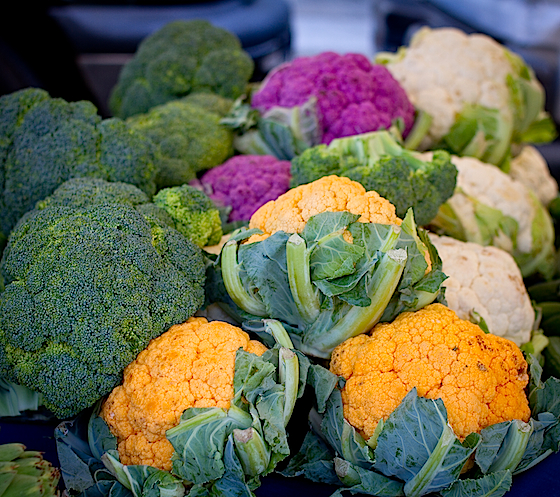
Four Wonderful Colors !
Facts About Cauliflower
By Dole
- Cauliflower is a vegetable.
- Cauliflower is a member of the Brassicaceae family of plants, which also includes broccoli, kale, cabbage, turnips, rutabags, Brussels sprouts and Chinese .
- Vegetables from the Brassicaceae family all share a common feature. Their four-petaled flowers bear the resemblance to a Greek cross, which
- explains why they are frequently referred to as crucifers or cruciferous vegetables.
- The scientific name for cauliflower is Brassica oleracea.
- The name cauliflower comes from the Latin words caulis, meaning “stalk,” andfloris, meaning “flower”.
- As its name implies, cauliflower is actually a flower! The part of the plant that we eat is the head of the underdeveloped, tender flower stems and buds.
- Do you know why cauliflower is white? It’s because while the plant is growing, the head is surrounded by heavy green leaves that shield it from sunlight. Without exposure to sunlight, the process called “photosynthesis,” in which sunlight produces a green pigment called chlorophyll, cannot happen.
- Most of the cauliflower produced in the United States comes from California, but China is the largest worldwide producer of cauliflower.
- Mark Twain once said, “Cauliflower is nothing but a cabbage with a college education”.
- Did you know that the green leaves at the base of a cauliflower head are edible? They have a stronger flavor than the florets and you need to cook them for longer.
- One-half cup of chopped cauliflower counts as one serving of vegetables.
- One serving of cauliflower contains 15 calories and 40 percent of your daily vitamin C!
- Cauliflower contains sulphorafane (“sul-for-ah-fane”) and indoles (“in-doles”), phytochemicals that may help reduce risk of certain cancers.
- The Spanish word for cauliflower is coliflor.
- The French word for cauliflower is le choux-fleur.
- The Italian word for cauliflower is il cavolfiore.
- The German word for cauliflower is blumenkohl.
Cauliflower nutrition facts
By Nutrition and You
Packed with rich nutrients, cauliflower or cabbage flower is one of the commonly used flower-vegetable. The flower heads contains numerous health benefiting phtyo nutrients such as indole-3-carbinol, sulforaphane etc that help prevent prostate, ovarian and cervical cancers.
Botanically, it is a member of the cruciferous or brassicaceae family; has got similar nutritional and phyto-chemistry profile with broccoli and cabbage. Several cultivars exists other than common snow-white variety including green, orange, purple, and romanesco heads.
Like broccoli, cauliflower is made up of tightly clustered florets that are begin to form but stopped at bud stage. This cool season vegetable prefers fertile rich adequate moisture in the soil to flourish.
To keep the flower heads creamy white, they should be protected from sunlight. This is done by tying the close-by leaves together over the heads when the heads are the size of a quarter. Over-maturity makes the heads get loose and grainy surfaced, and lose much of their tenderness.
Health benefits of Cauliflower
- Very low in calories. 100 g of fresh cauliflower has only 26 calories. However, it is very low in fat and contains no cholesterol.
- Its florets contain about 2 g of dietary fiber per 100 g; providing about 5% of recommended value.
- Cauliflower contains several anti cancer phyto-chemicals like sulforaphane and plant sterols such asindole-3-carbinol which appears to function as an anti-estrogen agent. Together these compounds have proven benefits against prostate, breast, cervical, colon, ovarian cancers by virtue of their cancer cell growth inhibition, cytotoxic effects on cancer cells.
- Also, Di-indolyl-methane (DIM), a lipid soluble compound present abundantly in brassica group of vegetables has found effective as immune modulator, anti-bacterial and anti-viral compound by potentiating Interferon-Gamma receptors and its production. DIM has currently been found application in the treatment of recurring respiratory papillomatosis caused by the Human Papilloma Virus (HPV) and is in Phase III clinical trials for cervical dysplasia.
- Fresh cauliflower is excellent source of vitamin C; 100 g provides about 48.2 mg or 80% of daily recommended value. Vitamin-C is a proven antioxidant helps fight against harmful free radicals, boosts immunity and prevent from infections and cancers.
- It contains good amounts of many essential B-complex group of vitamins such as folates, pantothenic acid (vitamin B5), pyridoxine (vitamin B6) and thiamin (vitamin B1), niacin (B3) as well as vitamin K. These vitamins are essential in the sense that body requires them from external sources to replenish and required for fat, protein and carbohydrates metabolism.
- It is also good source of minerals such as manganese, copper, iron, calcium and potassium. Manganese is used in the body as a co-factor for the antioxidant enzyme superoxide dismutase.Potassium is an important intracellular electrolyte helps counter the hypertension effects of sodium.
Cauliflower (Brassica oleracea (Botrytis Group)), raw,
Nutritive value per 100 g.
(Source: USDA National Nutrient data base)
| Principle | Nutrient Value | Percentage of RDA |
|---|---|---|
| Energy | 25 Kcal | 1% |
| Carbohydrates | 4.97 g | 4% |
| Protein | 1.92 g | 4% |
| Total Fat | 0.28 g | 1% |
| Cholesterol | 0 mg | 0% |
| Dietary Fiber | 2.0 g | 5% |
| Vitamins | ||
| Folates | 57 mcg | 14% |
| Niacin | 0.507 mg | 3% |
| Pantothenic acid | 0.667 mg | 13% |
| Pyridoxine | 0.184 mg | 14% |
| Riboflavin | 0.060 mg | 4.5% |
| Thiamin | 0.050 mg | 4% |
| Vitamin A | 0 IU | 0% |
| Vitamin C | 48.2 mg | 80% |
| Vitamin E | 0.08 mg | 0.5% |
| Vitamin K | 15.5 mcg | 13% |
| Electrolytes | ||
| Sodium | 30 mg | 2% |
| Potassium | 299 mg | 6% |
| Minerals | ||
| Calcium | 22 mg | 2% |
| Copper | 0.039 mg | 4.5% |
| Iron | 0.42 mg | 5% |
| Magnesium | 15 mg | 3.5% |
| Manganese | 0.155 mg | 7% |
| Zinc | 0.27 mg | 2.5% |
| Phyto-nutrients | ||
| Carotene-ß | 0 mcg | — |
| Lutein-zeaxanthin | 1 mcg | — |
Selection and storage
Cauliflowers are available all around the year in the markets; however they are at their best during winter months. In general, harvesting done when the head reaches the desired size but before the buds begin to separate.
In the stores, choose fresh heads featuring snow/creamy white, compact, even heads that feel heavy in hand. Grainy surface and separate heads indicate over maturity while green coloration may be due to over exposure to sunlight. Avoid heads with bruised surface as they indicate poor handling of the flower and those with dark color patches as they indicate mold disease known as downy mildew.
Once at home, store in the refrigerator set with higher relative humidity. They stay fresh for about a week.
Preparation and serving methods
Its creamy white flower heads are favored in variety of delicacies world-wide. To wash, place heads upside down rinsed in a large bowl of cold water or salt water brine for about 15-20 minutes to ensure removal of any insects, soil or fungicide/insecticide sprays. Gently pat dry using soft cloth. Remove tough stem and leaves.
Usually florets cut into equal sections to help cook evenly. Cook covered in a little boiled salted water until tender for few minutes. Overcooking may result in loss of nutrients especially vitamin C.
Here are some serving tips:
- Cauliflower mixes well with vegetables, lentils and meat.
- Aloo-gobi (Potato-cauliflower) is a very popular dish in south Asian countries especially in India, Pakistan and Nepal.
- The florets are added in pasta bake, casseroles and to make curry/soup.
- It is also widely used in pickling.
Safety profile
Like other members of the brassica/cruciferous family, prolong/excessive use of cauliflower may cause swelling of thyroid gland and thyroid hormone deficicency. This is due to the presence of certain plant compounds known as goitrogens in these group of vegetables. It is therefore advised to avoid, especially in individuals with thyroid dysfunction. However, these vegetables may be used liberally in healthy person.
———-
 FIT ~an~ HAPPY